
Elevate Magnetic Analysis to New Heights
Portable Spinning Magnetometer (PSM) Features and Functionalities
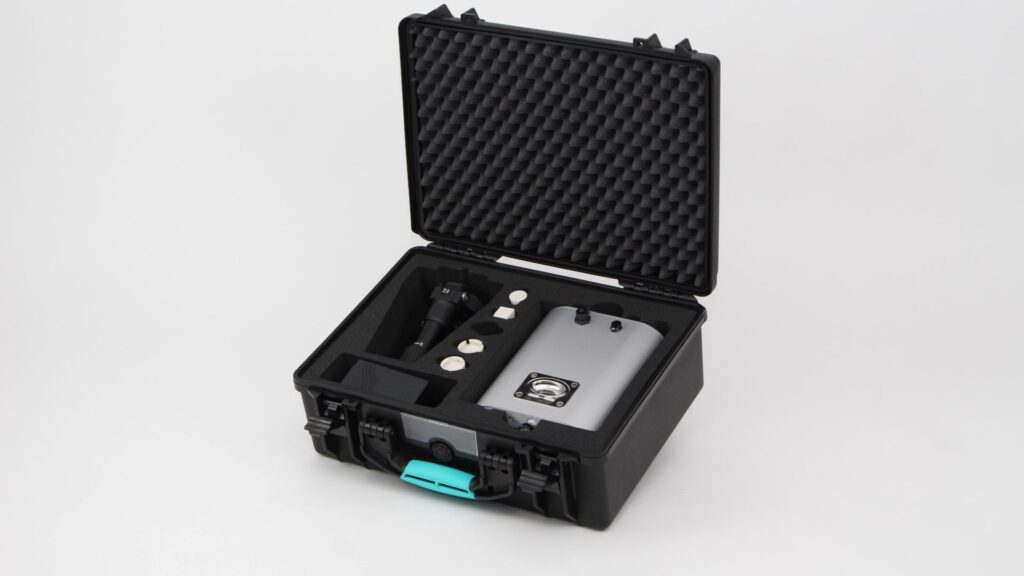

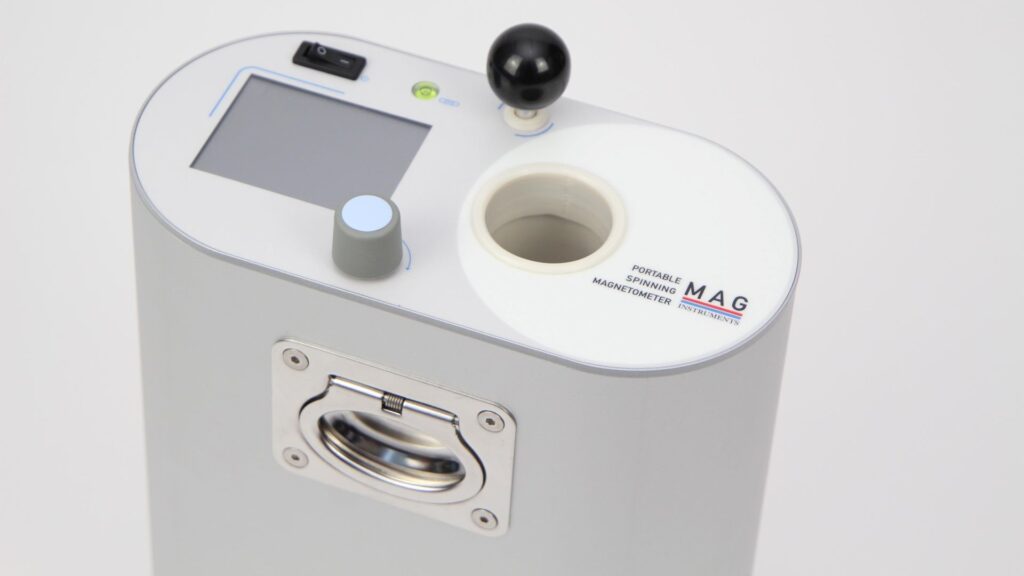

Exploring the Compact Power of the Portable Spinning Magnetometer (PSM)
The Portable Spinning Magnetometer (PSM) is a game-changer in the world of magnetic measurement. As the world’s most compact and affordable device, the PSM is specifically designed for the measurement of remanent magnetization of standard, homogeneous one-inch core samples. Unique in its ability to indicate the level of the sample’s homogeneity, the PSM is a perfect blend of rugged design and lightweight portability, making it ideal for both tabletop and fieldwork.
The PSM offers flexibility in operation, with the ability to be used standalone or remotely from a PC. Its graphic LCD display and control knob facilitate standalone operation, allowing for full control of the device without the need for an external computer. The device also features an inbuilt SD card for storing measurement results, eliminating the need for manual note-taking. For those who prefer PC control, the PSM can be fully operated from a PC connected via a USB interface, with Windows-based software provided for device control and data storage.
Our comprehensive brochure provides an in-depth exploration of the PSM’s capabilities. From precise measurement to its unique homogeneity indication feature, the brochure details the many ways the PSM can enhance your research.
Main Purposes
- Precise measurement of remanent magnetization in standard, homogeneous one-inch core samples.
- Collection of accurate data on the magnetic properties of various materials, aiding researchers in their studies.
- Indication of the level of sample homogeneity within a sample, providing critical insights into the uniformity of the sample’s magnetic properties.
Key Features
| Truly portable, table-top magnetometer | The included tripod and long-lasting (2-5 days) internal battery allow you to use it anywhere in the laboratory, classroom, or during fieldwork |
| Standalone and PC-controlled operation | The graphic LCD screen, control knob, and integrated SD card allow the instrument to work either as a full standalone device or remotely controlled by a connected PC |
| Easy and rapid measurement procedure | Intuitive software and automatic measurement progression ensure an efficient workflow |
| Large dynamic range | Its large measurement range spanning nine magnitudes with a noise level of only 1×10⁻⁹ Am2 promotes a wide range of applications, from analyzing weakly magnetic sediment and soil samples to investigating strongly magnetized volcanic rocks or synthetic materials |
| Most affordable rock magnetometer on the market | Affordability and a small footprint make the PSM an ideal addition for dedicated paleomagnetic laboratories, as well as interdisciplinary research groups interested in magnetic measurements |
| Measurement of fragile samples | The PSM’s slow spinning rate of 2 Hz allows the measurement of fragile materials, such as unconsolidated sediments |
Additional Functionalities
- Custom exchangeable sample holders for a variety of sample sizes and geometries
- Sensor for detecting lowered samples, enabling automatic progression through different sample orientations
- Automatic adjustment of attenuation and rotations based on sample strength
These features and functionalities make the PSM a versatile and portable device for the measurement of remanent magnetization in standard core samples. Its compact design, easy operation, and additional functionalities enhance the magnetic analysis process and enable efficient data collection.
Specifications
| Specification | Value |
|---|---|
| Dynamic range | 1×10⁻⁹ – 0.1 Am2 (1×10⁻⁴ – 1×10⁴ A/m) |
| Sensitivity | <1×10⁻⁹ Am2 (1×10⁻⁴ A/m) |
| Precision1 | < 5% |
| Sample types | 1-inch cylindrical, 23mm cube, ODP prism, others upon request |
| Continuous measurement time2 | > 10 h |
| Dimensions (WxDxH) | 20 cm x 10 cm x <28 cm |
| Weight3 | 3.5 kg |
| Spinning frequency | 2 Hz |
| DC power supply | 12 – 20 V (recommended 19 V) |
1 Worst-case precision at the boundary of sensitivity (1 x 10⁻⁸ ) expressed as SD normalized by the mean value. Specifications provided for homogeneous samples
2 Operation time given that measurement is performed continuously one after another. In case of pauses between measurements, the battery lasts longer
3 Weight of PSM only, without auxiliary components (power supply, case, tripod)
Dedicated Software
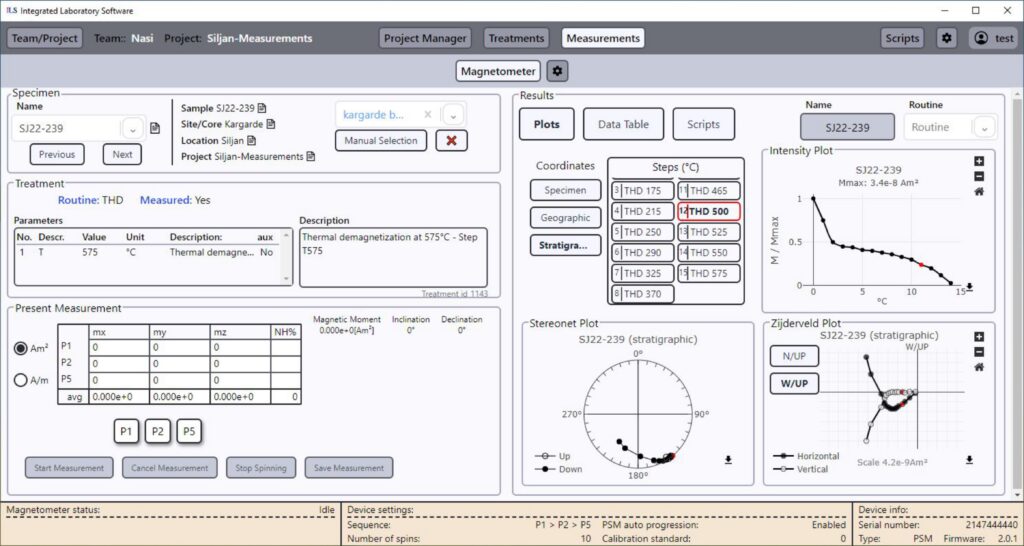
The PSM is operated through Integrated Laboratory Software (ILS), a dedicated control and data-management software. ILS provides a structured data model with a Project → Site → Sample → Specimen hierarchy, enabling users to capture and maintain complete metadata at each level. All entities can be created, edited, and deleted directly within the software. Specimens can also be grouped flexibly, allowing batch processing and faster, more consistent analysis across multiple specimens.
For paleomagnetic workflows, ILS includes a comprehensive library of standard measurement routines, including NRM, AFD, THD, IRM, ARM, AARM, and BF, as well as user-defined routines. This enables users to build, execute, and save multi-step measurement sequences across individual specimens or specimen groups. For each measurement step, ILS displays the required specimen orientation on the sample holder, and during an automated sequence (up to six positions), no additional user input is required; after completion, the software automatically advances to the next specimen in the measurement list. Results are displayed in real time in both tabular and graphical form, including Mx, My, Mz, |M|, D, I, Dg, Ig, Ds, Is, with visualization via stereonet and Zijderveld plots in specimen, geographic, and tectonic coordinates, using N/Up and W/Up projections. Results can be exported per specimen or per group in multiple formats.
In addition, ILS provides a Python interface for direct access to the project database. Users can develop custom Python scripts to query and parse measurement data, perform advanced data processing, generate custom plots, and export in user-defined formats. Scripts can be shared and collaboratively developed across laboratories, creating a collaborative library of reusable tools for data processing, visualization, and export.
Measuring Remanent Magnetization and Indicating Sample Homogeneity
PSM Application Fields
Whether unraveling the mysteries of Earth’s magnetic past or studying environmental changes, the Portable Spinning Magnetometer (PSM) empowers researchers to delve deeper into the magnetic world and extract valuable insights from their samples.
Paleomagnetism
- Determination of characteristic magnetic remanence direction and magnetization intensity in oriented rock samples or burned archaeological artifacts.
- Plate tectonic reconstructions, investigation of the nature and history of the geomagnetic field, and magnetostratigraphy.
Geochronology
- Dating of rock sequences (lava flows or sediments) through polarity and paleointensity magnetostratigraphy.
- Provides insights into the chronological framework of geological formations.
Rock Magnetism
- Investigation of the magnetic properties of rocks, sediments, or soils.
- Understanding the formation processes of rocks and the acquisition of their magnetization.
- Determination of proxy parameters related to grain size, mineralogy, or origin of the investigated materials.
Archaeology & Magnetometry
- Characterization of the magnetic properties of soil samples and other materials from archaeological sites.
- Refinement of the interpretation of magnetic anomalies in magnetograms.
- Determination of paleointensity of baked archaeological artifacts for dating purposes.
Environmental Sciences
- Assessment of environmental changes using the magnetic properties of soil and sediments.
- Proxy indicators for paleoclimatic and paleoceanographic studies.
Please note that some of these applications require the use of additional demagnetizing equipment. The PSM itself serves as a tool for measuring remanent magnetization and indicating sample homogeneity in standard, homogeneous one-inch core samples.